Splintered Frames: How Requiem for a Dream Wrote the Grammar of Our Doomscroll
There is a moment early in Requiem for a Dream when the screen refuses to be one thing. Harry and Marion lie in bed, and Aronofsky splits the frame down the middle: two bodies, two halves of a relationship, one line of pixels between them. It is a stylistic flourish, yes, but it is also a way of seeing. The film does not trust a single, stable image. Neither, by 2026, do we.
The Grammar of the Interrupted Thought
Darren Aronofsky’s 2000 adaptation of Hubert Selby Jr.’s novel is usually discussed as a film about addiction: heroin, diet pills, the dream of a better life. That reading holds. But watch it now, on a laptop with a phone face-down beside you, and its editing starts to feel less like a metaphor for substance dependence and more like a description of the environment we all live in. The split screen, the hip-hop montage, the snorricam, the time-lapse of a window changing from day to night — these are not just ways of showing Harry, Tyrone, Marion and Sara falling apart. They are ways of showing a consciousness that cannot hold a thought for more than a few seconds.
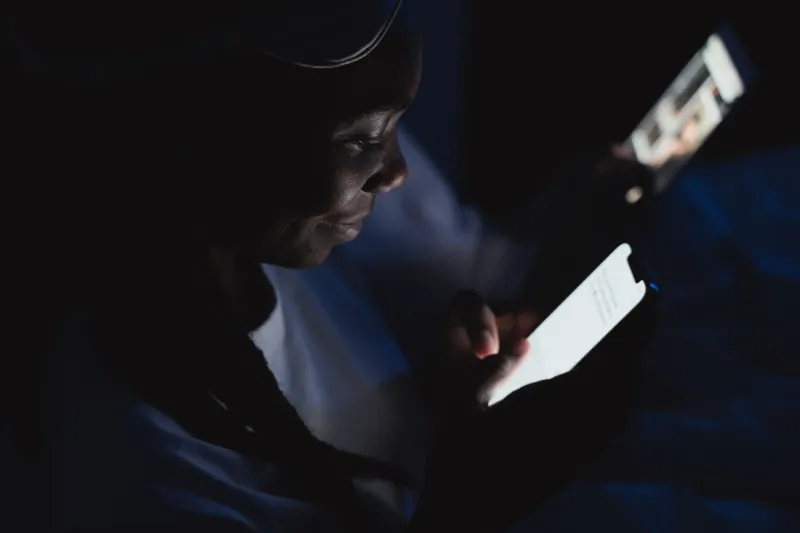
Aronofsky and editor Jay Rabinowitz cut the film like a nervous system in overdrive. The famous 'hip-hop montage' — a rapid-fire sequence of preparation, injection, pupil dilation — reduces a ritual to a burst of images. It is stylish, funny, horrible. It is also, structurally, a TikTok. Not literally, of course. But the logic is familiar: a sequence of hooks, each one lasting just long enough to register, each one demanding the next. In 2026, that logic is everywhere. The group chat pings during the closing credits. The streaming service asks if you are still watching. The phone lights up the ceiling at 1am with a notification you did not ask for.
A Hip-Hop Montage for a Notification Age
The film’s split screen does something subtler than the montage. It divides attention on purpose. When Harry and Marion share the frame but not the same space, we are asked to read two things at once. When Harry and Tyrone walk through Coney Island and the screen splits into multiple panels, the film is showing friendship as a set of parallel tracks. It is a visual grammar of multitasking — and of the anxiety that comes with it.
Britain in 2026 is a country of split screens. We watch iPlayer on a TV while scrolling on a phone. We follow a football match on one tab and a group chat on another. We read the news in fragments, each headline a small cut. Ofcom’s annual surveys keep finding that attention is spread thinner across more devices; the details change, but the direction does not. The split screen is no longer a bold formal experiment. It is the default shape of an evening.
What makes Requiem so prescient is not that it predicted smartphones. It is that it understood the texture of fractured attention long before the smartphone became the main event. The film’s visual anxiety — the fisheye lenses, the extreme close-ups, the cuts that land before you have finished processing the last one — now reads less like stylised addiction and more like a diagnosis of everyday screen life. We are not all addicts in the film’s sense. But many of us recognise the feeling of a brain that will not settle, a day chopped into notifications, a night spent doomscrolling through other people’s lives.
The Afterlife of the Fracture
You can trace the technique’s afterlife across UK film and television. The texting overlays and split-screen chatter of Skins took the grammar of Requiem and made it teenage. Sherlock turned on-screen text into a character. I May Destroy You used overlapping timelines and rapid cuts to show trauma as a perceptual glitch. Industry splits the frame and the timeline to show a world of people who are always half somewhere else. Even the humble British panel show has absorbed the rapid-cut montage: a joke, a reaction, a cut, a caption, another reaction. The grammar is everywhere because it works. It mimics the way we actually watch now.
But there is a difference between using the grammar and being about it. Requiem is about it. The film’s form is not a garnish on the story; it is the story. Harry’s addiction, Sara’s addiction, Marion’s addiction, Tyrone’s addiction — each is rendered as a narrowing of attention. The world gets smaller, faster, more insistent. The split screen is a symptom, not a solution. It shows a mind that has lost the ability to be in one place.
Diagnosis, Not Just Style
That is why the film still stings in 2026. We have built an economy around the same fracture. The notification, the autoplay, the infinite scroll: these are not accidents. They are design choices that monetise a brain that cannot sit still. Requiem’s visual language is a warning about what happens when a person’s attention is captured by a chemical or a habit. Our visual language is a warning about what happens when an entire culture’s attention is captured by a business model.
None of this makes Requiem a documentary about the internet. It is still a film about four people in Coney Island, and it is still devastating on its own terms. But the split screen has become a kind of time capsule. It shows us a technique that once felt radical and now feels ordinary. It shows us a film that was accused of showing off and now looks like a premonition. And it asks a question that is harder to answer in 2026 than it was in 2000: when the screen is already split, where do you put your attention?
Sitting Still in the Splinters
The film’s final act offers no comfort. The split screen gives way to a montage of four bodies in four kinds of hell, cut together until the images lose their individual weight. It is almost unbearable. But it is also, in a strange way, a demand. Sit with this. Do not scroll away. The film refuses to let you consume it in fragments, even as it uses fragments to tell its story.
That might be the most useful thing Requiem for a Dream can do in 2026. It does not offer a cure for the attention crash. It offers a room where the crash is visible. For two hours, the split screen is not a symptom of our distraction but a way of looking at it. And in a culture that profits from keeping us fractured, that is still a radical thing: to sit in the dark, with one screen, and let a film take its time.