After the Last Deckchair: Requiem for a Dream and the Out-of-Season Seaside
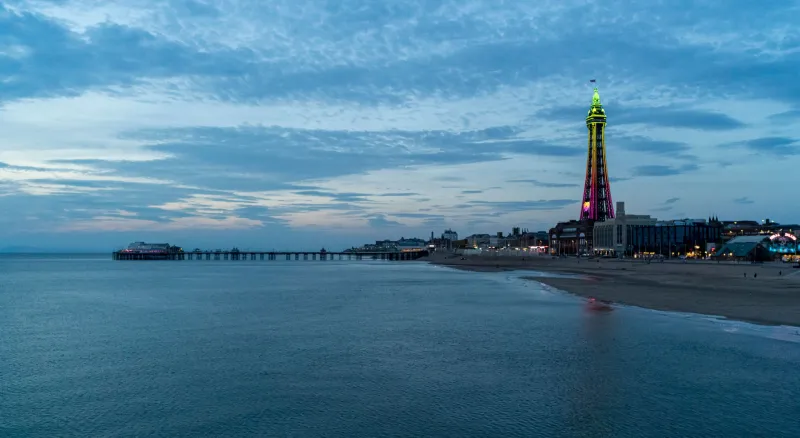
Blackpool in November is a particular kind of quiet. The illuminations are still on—switched on in late summer, not due off until the new year—but the promenade has thinned out. The arcades are open, the chip shops are open, the waxworks are open, and yet the town feels like it is holding its breath. Margate on a wet Tuesday has the same quality: Dreamland’s rides tested and waiting, the Turner Contemporary doing steady off-season business, the seafront cafés serving to a handful of locals who know the staff by name. This is the British seaside after the season has ended but before the town has fully admitted it.
Requiem for a Dream has always been read as an American film about American appetites. Coney Island, the boardwalk, the parachute jump, the faded carnival—these are Brooklyn landmarks, and Aronofsky shoots them as dream architecture. But watch the film again in 2026, preferably on a grey afternoon with the heating on and the rain against the window, and the geography starts to shift. The amusement park in Requiem is not just Coney Island. It is any coastal town where the machinery of pleasure has outlived the crowd.
The Dream Machine and the Empty Promenade
The film’s amusement-park imagery works because it is simultaneously grand and depleted. The parachute jump is a vertical promise—up, up, away from the housing blocks and the heat. The boardwalk is a stage for people who want to be seen. The carnival lights are bright enough to suggest that something is happening, even when nothing is. That is the grammar of the British seaside out of season, too. Blackpool’s Tower is still lit; the Winter Gardens still have a programme; the Pleasure Beach still runs its rides when the weather allows. But the town’s economic engine is idling. The season is short, the margins are thin, and the infrastructure—piers, promenades, tram tracks, Victorian arcades—costs more to maintain every year.
Aronofsky’s Coney Island is not a documentary. It is a mood. But that mood travels. The wet concrete, the neon reflected in puddles, the forced perspective of a ride that looks bigger than the people queuing for it—these are visual clichés of the British coast as much as the American one. When Harry and Marion walk the boardwalk, they are moving through a landscape that has been designed to make them feel like the day could still turn good. That is what seaside towns do. They sell the possibility of a better afternoon.
What the Off-Season Reveals
In 2026, the British seaside is having one of its periodic identity crises. Domestic tourism is squeezed; councils are cutting services; several piers and pavilions are waiting on repair bills that no one wants to sign. Blackpool’s illuminations have been extended and rebranded as an economic lifeline, pulling visitors into the autumn. Margate’s Dreamland has had its own stop-start history, part heritage attraction, part cautionary tale. These are not failures of taste. They are failures of the seasonal economy—the same economy that built Coney Island and then left it to the developers.
Requiem for a Dream understands that the amusement park is not just a place. It is a promise that has already been broken. Sara Goldfarb sits in her apartment and watches infomercials; the game show is her Coney Island, a brightly lit machine that says she could still be chosen. The British seaside out of season has the same structure: the lights are on, the rides are tested, the signage is cheerful, and the wind is coming off the sea with nothing to stop it. The dream is not absent. It is simply under-occupied.
A Different Kind of Dark Cinema Trip
This is why Requiem for a Dream still works as coastal cinema in 2026. We tend to file dark films under urban alienation—the tower block, the subway, the night bus. But the coast has its own unease. Off-season seaside towns are full of spaces that were designed for crowds and are now serving a handful of people: the empty ballroom, the closed kiosk, the arcade with half its machines switched off. That is Requiem’s visual register. It is not about noise. It is about the echo after the noise.
Next time you watch the film, try it after a walk along a British promenade in the rain. The Clint Mansell score—those strings that refuse to release—will sound different against the hum of a neon sign and the distant clatter of a ride being tested. The film’s Coney Island sequences will stop looking like an American postcard and start looking like a forecast. The seaside out of season is a Requiem set without the plot: the lights are on, the tide is in, and the dream is still for sale, slightly reduced.
The Lights Are Still On
There is a temptation to treat Requiem for a Dream as a warning about drugs, or diet pills, or television, or America. It is all of those things. But it is also a film about the machinery of hope—who builds it, who maintains it, who gets to ride it. The British seaside knows that machinery intimately. Blackpool’s illuminations are not ironic. They are an act of civic stubbornness, a decision to keep the lights on even when the season has turned. Requiem’s boardwalk is the same decision, shot through with dread. The melancholy is not imported. It is already here, in the wet car parks and the closed kiosks and the arcade that stays open just in case.